
Emotional Eating:From Understanding to Healing
10. September 2026
Emotional eating: what I shared at Trizara Nutrition and Business Center in Amman, Jordan
On 5 July 2024, I was invited by Trizara Nutrition and Business Center in Amman, Jordan, to give a seminar on emotional eating. Why do we reach for food when we are not hungry, and why is it so hard to stop? Here are five ideas from that day.
1. Why some foods hook us
For most of human history, our greatest threat was hunger. Evolution gave us a strong drive to eat whenever food was available, and only a weak “brake” to stop us. In today’s world of plenty, that advantage has become a risk.
Ultra-processed foods make it even harder. Nature rarely combines carbohydrates and fat in equal amounts: an apple is almost pure carbohydrate, salmon almost pure fat. A chocolate bar, however, is roughly half and half. This combination, rarely found in nature, sends an especially strong reward signal to the brain. These foods are also soft, quick to eat and easy to absorb, so the reward arrives fast. For a brain searching for comfort, this is the perfect hook.
2. Why quick-fix diets backfire
People who struggle with impulse control are often impatient, not only with others, but with themselves. They are the first to try the magic diet promising “guaranteed results in record time”. Yet the solution is not in finding the perfect plan. It lies in understanding why we overeat in the first place.
Strict calorie restriction, applied before the emotional drivers are understood, can make the relationship with food even worse. Research shows that dieting, and especially severe dieting, greatly increases the risk of developing disordered eating. Fast success then turns into even faster disappointment, and the weight returns, often with a few extra kilos.
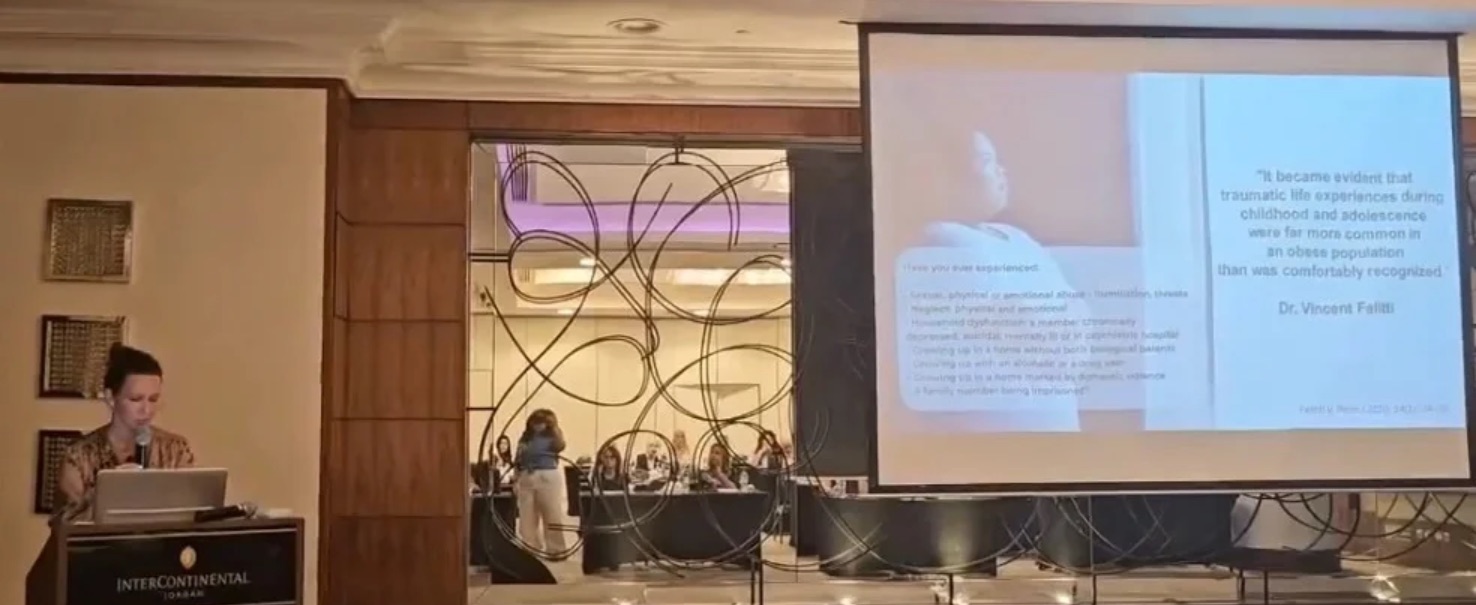
3. What trauma really is
We often call emotional eating “comfort eating”. The word comfort comes from the Latin confortare, to strengthen: we eat to feel stronger against pain we cannot carry, whether loneliness, fear, stress or hurt.
Not every painful experience becomes trauma. As Dr. Gabor Maté explains, we do not get traumatized because we get hurt, but because we are alone in that hurt. Pain that is never shared stays inside us and quietly governs our behaviour, and food becomes one way to soothe it. That is why he says the question is not “Why the addiction?” but “Why the pain?” For emotional eating, it is not “Why the food?” but “Why the pain?”
Yet we can only look at our pain when we feel safe enough to do so. Otherwise it is too overwhelming, and we keep escaping, into food among other things. And safety, in his words, is not the absence of threat, but the presence of connection. So if trauma begins with being alone in our pain, healing begins with not being alone: with someone who listens without judging.
4. Five steps toward healing from emotional eating
Inspired by Dr. Gabor Maté, I shared five steps with the participants:
Re-label. “I need chocolate” becomes “I notice a thought telling me I need chocolate.” It is a belief, not a real need.
Re-attribute. Understand where the urge comes from, with compassion rather than blame. It is not a moral failure, but the effect of circumstances you did not choose.
Re-focus. Teach your brain that it does not have to obey the call.
Re-value. See the false gold for what it is: worth far less than the urge promises.
Re-create. Ask yourself what life you truly want, and begin choosing it.
5. Reward the process, not the goal
Dopamine is not only about reward. It is about pursuit. If we only measure ourselves against a distant goal, the gap feels overwhelming. Instead, reward each step: “This is me, improving.” Support your brain’s reward system naturally, through sleep, sunlight, movement, time with loved ones, music, creativity and whole foods rich in protein, fruit and vegetables.
Seeing the person, not only the behaviour
For all of us who work with people struggling with food, the most important shift is this: behind the behaviour there is often a human being in pain, with the full potential to heal and grow, at any age.
That is why my work always brings together three pillars: nutrition, physical activity and emotions.
My warm thanks to Trizara for the invitation, and to everyone who joined with such open hearts and minds.
If you would like me to speak at your event or organisation, write to me at melzer@equiliberty.org.
Be balanced, be free